
Source: Indiana Capital Chronicle | July 15, 2026
Indiana will discontinue aspects of a diversity program it used for decades to recruit minority and female contractors after the state attorney general determined the program’s race and gender preferences were unconstitutional.
Gov. Mike Braun announced Wednesday morning he will replace race- and sex-based contracting preferences in the Minority and Women’s Business Enterprises Program and Indiana’s Diversity Business Enterprises Program with a merit-based system.
“Our Constitution mandates equal protection under the law, because a system where the government picks winners and losers on the basis of race or sex can never be fair,” Braun said in a statement. “Indiana has replaced divisive, politically-charged programs with a focus on Merit, Excellence, and Innovation: a level playing field where every single Hoosier has the chance to get ahead with hard work.”
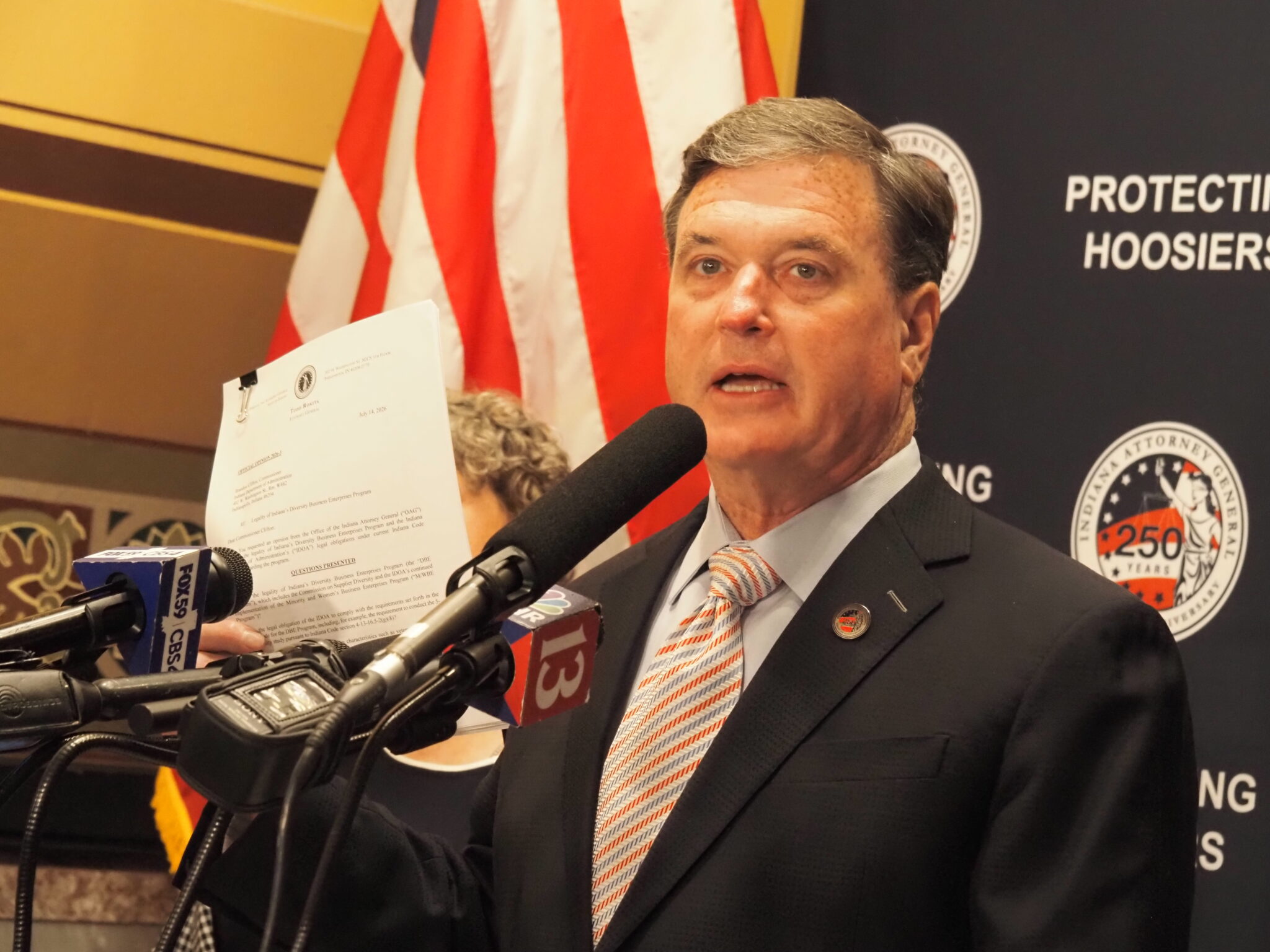
The decision — criticized by Democratic lawmakers as a revival of preferential treatment for insiders — follows a legal review conducted by Attorney General Todd Rokita, who issued an opinion this week finding race- and sex-based preferences violate the constitution’s equal protection clause.
The opinion cites the U.S. Supreme Court’s 2023 ruling in Students for Fair Admissions v. Harvard, which found racial preferences in college admissions violated the 14th Amendment.
“This program doesn’t survive the U.S. Supreme Court’s highest level of review,” Rokita said. “It relies on explicit racial and sexual classifications in state contracting, the very thing the Equal Protection Clause was written to prohibit. Our Constitution demands colorblind government treating every business without regard to race or sex.”
The changes will only affect new contracts, not existing ones.
Braun administration sought opinion
Department of Administration Commissioner Brandon Clifton requested the legal review last August, referring to the Supreme Court decision and a memorandum from the U.S. attorney general warning against unlawful discrimination by federally funded entities.
Clifton’s request covered the entire diversity business program — enacted by law in 1983 to promote diversity in state contracts — and asked whether the division needed to comply with state law requiring a five-year diversity study due last year.At the time of his request, the division’s diversity participation goals were set at an average of 8% for minority-owned businesses and 10% for women-owned businesses.
Rokita’s nonbinding opinion found race- and sex-based preferences unconstitutional, but determined preferences for veteran-owned businesses are lawful.
“This blatantly illegal program singles out some Hoosiers for disfavored treatment purely because of their sex or the color of their skin, and it insults other Hoosiers by suggesting they cannot compete on a fair playing field. The program is both un-American and unconstitutional,” Rokita said.
Can the governor act without the legislature?
Democratic lawmakers questioned Braun’s authority to take action without legislative repeal or a lawsuit.
“We now have an imperial governor,” Indianapolis Rep. Ed DeLaney said. “In the Braun administration, there seems to be no room for the legislature, no room for the courts.”
DeLaney objected to the administration’s portrayal of the program as one awarding preferential treatment to women and minorities, saying the statute establishes goals — not preferences. “No company was told ‘you get this job solely because you’re a minority,’” he said.
Rokita acknowledged the governor’s action Wednesday is “an unusual step,” but one he believes is “firmly supported” because the law is unconstitutional.
He said lawmakers failed to repeal provisions of the statute following the Supreme Court’s 2023 decision.
“We advised the General Assembly very directly, very often, that they had an unconstitutional and therefore illegal law on their books,” Rokita said. “They have done nothing. The governor and I have done something today.”
The program set diversity goals in most state contracts.
Rokita said this required bidders to submit detailed subcontractor plans to demonstrate they would meet racial and gender quotas or make good faith efforts to meet those goals, which he said could result in penalties like rejected bids, withheld payments, terminated contracts and debarment from future work for firms that did not comply.
“The government put its thumb on the scale against any business not owned by someone in the state’s favored racial or gender categories,” he said. “This wasn’t just special treatment. It was discrimination.”
Deputy Attorney General Blake Lanning said there is federal precedent to not implement a statute when the law is “clearly unconstitutional.”
“If we were in court trying to defend this (statute), there is no straight-faced argument to defend the state engaging in this type of discrimination,” he said, “and I think this is one of those rare circumstances where we say the governor does have the unique authority and duty under his constitutional oath to take a step like this.”
What’s next
The Department of Administration will now decide how to unwind the race- and sex-based elements of the program, with the Attorney General’s office advising the administration through the transition.
Rokita said his office will continue to work with lawmakers to repeal the underlying statute, though he has yet to hear from Republican leadership if they intend to consider the issue next session.
Asked if he is concerned about potential lawsuits, Rokita said: “We’re prepared for anything and everything, and we’ll win.”
The decision quickly drew condemnation from Democratic lawmakers, the Black Legislative Caucus and faith groups.
Indianapolis Rep. Mitch Gore issued a statement Wednesday calling the decision “bad public policy” and a “failure to faithfully execute the laws enacted by the Indiana General Assembly.”
“For more than forty years, Indiana has recognized that expanding opportunities for qualified minority- and women-owned businesses strengthens our economy, increases competition and delivers better value for taxpayers,” Gore said. “That policy is not merely an executive initiative — it is the law.”
He continued, “The Governor has now chosen to dismantle that statutory framework based upon an advisory opinion from the Attorney General. That is not how our constitutional system works. The Attorney General does not invalidate statutes. The Governor does not repeal laws.”
Indiana Senate Democratic Leader Shelli Yoder, D-Bloomington, described the governor’s proposed merit-based system as a “VIP entrance for the wealthy” and a “euphemism for preserving the status quo.”
Rep. Earl Harris Jr., D-East Chicago, who chairs the Black Legislative Caucus, said the diversity business program exists “because ‘race-neutral’ policies failed for decades to ensure marginalized communities were given equal opportunities,” due to limited access to capital and exclusion from professional networks.
“Equal opportunity is not discrimination,” the Rev. David W. Greene Sr., president of Concerned Clergy of Indiana, said in a statement Wednesday calling on the governor to meet with faith leaders and minority business owners. “Opening doors for qualified people who have historically found those doors closed is not favoritism; it is fairness.”